Home » Archives for Omar Dahir

Author: Omar Dahir

Cardinal Pell

My experience of Cardinal George Pell


I am sure Cardinal Pell had many virtues for which he will be rewarded. He was no doubt sincere in his convictions. He will be judged according to his own conscience. I remember him as a fierce opponent of women in holy orders.

The scene was set in 2010. I had been invited to be a guest speaker at the annual conference of the Ordination of Catholic Women at Hobart in Tasmania. The group was very active at the time. Regretfully it was discontinued recently by lack of resources.

After the conference I hopped across the Bass Strait to Melbourne and then Sydney. My purpose was both to visit family members living in Australia and make new contacts in my campaign for women’s ordination.

In Sydney I stayed at the Holiday Inn. At the suggestion of a friend, I placed an ad in a local newspaper saying: “John Wijngaards, Catholic theologian convinced women should be ordained. If interested ring (followed by my telephone number at the hotel)”. Five fruitful calls came in on the first day. One was from a religious sister who had obtained a doctorate in sociology on a thesis exploring the special charisms women bring to leadership.

From the second day onwards all my incoming calls at the hotel were deleted. Management explained that they had received a protest from Archbishop’s House. And, anyway, my room telephone should not be used for advertising purposes …

I knew, of course, that Sydney was the stronghold of Cardinal Pell, a well-known opponent of the ordination of women. In earlier years he had gone on record as saying: “Ordain a woman? You might as well try to ordain a potato!” But more was to follow.

One of the fruitful responses to my advertisement came from the priest who at the time was in charge of Reconciliation Church in Phillip Bay, on the outskirts of Sydney. He too supported the ordination of women. The community gathering at his church was a mixture of open-minded aboriginals and westerners. So he  invited me to address the community at the end of their next Sunday Mass at 11.00 am. I accepted.

However, on the Saturday the priest got in touch with me. Cardinal George Pell had heard about the invitation and disapproved. In fact, the priest was told not only that I should not speak in the church but that I should be physically prevented from entering the church! The priest was upset about this. So he proposed a compromise. After the Mass, which he would keep short, he would invite his community to come and meet me in a local Café so that they could hear what I had to say.

And so it was done.

I patiently waited outside the Church during Mass. The area is full of aboriginal families. I found a bench to sit on, which provided also the opportunity to talk to some local aboriginal youngsters who were playing around at the time.

At a quarter past twelve the priest came out of the church, followed by a sizable group of parishioners. We walked to the Daily Dose Café and Restaurant which turned out to be quite large. There, over a cup of coffee, I explained to a gathering of over fifty participants why I believe women should receive ordination. It was followed by a lively discussion.

I sent a message to Archbishop’s House asking for an interview with Cardinal Pell. I received a response saying that the Cardinal’s schedule was full. So much for the freedom of research and freedom of speech laid down for theologians by Vatican II.


John Wijngaards

remembering Jackie

Remembering Jackie

Ever since my dear Jackie passed away last year, friends in DGV have been asking me how we met. Well, here is the story.

It happened in a furniture shop on Abids Road, Hyderabad, India. I was looking for a bookshelf. So was she, but on a grander scale: to line the walls of a study room in the large girls school she was headmistress of.

We laughed and joked together. I remember her pointing at a statue of ‘Happy Jo’, a squatting buddhist monk with hands folded on his fat belly and a smile across his face. He is the Indian symbol of good fortune. “You’ll have to eat a lot more, to become like him!”, she said to me.

I still miss Jackie a lot and so do others. She possessed many talents and skills. She made life-long friends wherever she went. She wrote poetry. As an artist she created memorable images with a unique style of her own. Every year she sent out all over the world hundreds of Christmas cards designed by herself. She loved taking intriguing photographs of nature.

To record some of all this I have put together a Memorial Archive for her on our common website. If you have access to the internet, you will find the archive here: http://www.wijngaards-clackson.com/jackie-clackson/ . I will briefly sketch the contents of this archive.

Even among the people who knew her, few are aware of her interesting past. In the archive I outline her life story in six chapters. Jackie only found her belief in God and her acceptance of the Catholic faith as a college student. She herself describes the process in some detail. Then, after serving as an art teacher for some time, she joined the Franciscan Missionaries of Mary and was sent to India. In Hyderabad and Kazipet, Andhra Pradesh, she became headmistress of major girl schools. When she returned to England in 1982, she joined me in establishing Housetop Centre for Faith Formation which has now grown out into the Wijngaards Institute for Catholic Research.

It is difficult to do justice to Jackie’s art. In the paragraphs that follow I print out one of her poems which she called ‘Celebrating shared living’. Notice how she avoided using capital letters. Also: no commas, no fullstops.

“new life
becomes mine in the Lord
mine,
in the measured dancing of a new day

this life burns within
as a conscious wondering
which cannot be burnt out
by the death of destruction

I live with you
my friends –
of the same earth
and the same air –

may I come to know you
if I reach out with care
to share with you
the wealth of our becoming?

awakening together to the
everlasting smile
of the days for meaning
to all our belonging”


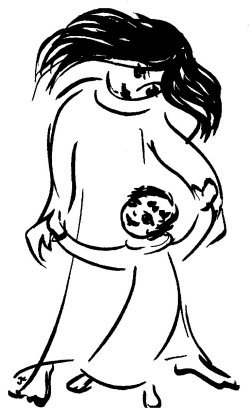
In her drawings Jackie did not use the technique of filling patches on the screen. Instead, she constructed images by just a few powerful strokes of her brush. This is quite difficult to do. If one stroke goes wrong, the whole image is spoiled.

Jackie used this technique to paint elaborate images of Gospel scenes for our Walking on Water educational videos. I provide samples in the Archive.

This was a truly international production. The videos were translated into 14 world languages and distributed in more than 40 countries. Because of this international character, Jackie was careful to avoid the one-sided ‘European’ presentation of Gospel personalities that was still common at the time.


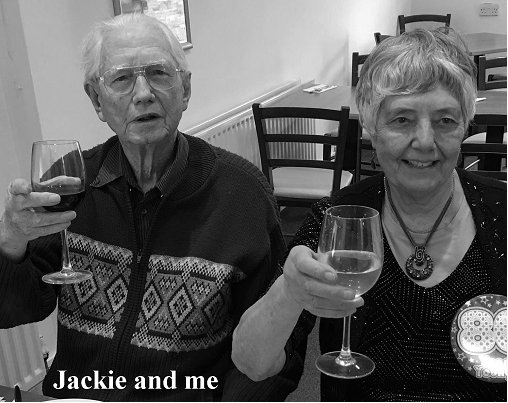
I have also posted many photographs on Jackie’s Memorial Archive. Some depict the many fascinating scenes of nature Jackie photographed: plants, insects, skies, you name it. Others show her together with me and in the company of friends on many different occasions. Allow me to conclude with one that was taken on her eightieth birthday three years ago.

Hans Wijngaards